Posts

Showing posts with the label Civil Material Testing

HOW TO DO FLEXURAL STRENGTH TEST OF CONCRETE?

Image
FLEXURAL STRENGTH TEST OF CONCRETE OBJECTIVE To determine the Flexural Strength of Concrete, which comes into play when a road slab with inadequate sub-grade support is subjected to wheel loads and / or there are volume changes due to temperature / shrinking.   REFERENCE STANDARDS IS: 516-1959 – Methods of tests for strength of concrete  

Standard Consistency Test - Test on Cement

Image
Standard consistency test is to determine the quantity of water required to produce a cement paste of standard consistency. Standard Consistency The standard consistency of a cement paste is defined as that consistency, which will permit the vicat plunger to penetrate to a point 5 to 7mm from the bottom of the vicat mould when tested as described below. Apparatus Vicat apparatus Movable rod Graduated scale Vicat mould Needles Needle for initial setting time. Needle for the final setting time. Procedure Take 400gm of cement in a pan and a weighted quantity of water in a beaker.Prepare a paste of weighed quantity of cement with a weighted quantity of potable or distilled water,taking care that the time of gauging is not less than 3 minutes,nor more than 5 min,and the gauging shall be completed before any sign of setting occurs The gauging time shall be counted from the time of adding water to the dry cement until commencing to fill the mould.Fill the vicat mould...

Test on hardened concrete - REBOUND HAMMER

Image
REBOUND HAMMER Non-Destructive Test AIM To assess the likely compresive strength of concrete by using rebound hammer as per IS: 13311 (Part 2) - 1992. PRINCIPLE The rebound of an elastic mass depends on the hardness of the  surface against which its mass strikes. When the plunger of the rebound hammer is pressed against the surface of the concrete, the spring-controlled mass rebounds and the extent of such a rebound depends upon the surface hardness of the concrete. The surface hardness and therefore the rebound is taken to be related to the compressive strength of the concrete. The rebound value is read from a graduated scale and is designated as the rebound number or rebound index. The compressive strength can be read directly from the graph provided on the body of the hammer. APPARATUS Rebound hammer PROCEDURE Before commencement of a test, the rebound hammer should be tested against the test anvil, to get reliable results, for which the man...

Concrete - Workability - Compacting Factor

Image
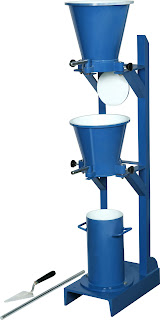
AIM To determine the workability of fresh concrete by compacting factor test as per IS: 1199 - 1959.  APPARATUS COMPACTING FACTOR APPARATUS  Compacting factor apparatus  PROCEDURE The sample of concrete is placed in the upper hopper upto the brim. The trap-door is opened so that the concrete falls into the lower hopper. The trap-door of the lower hopper is opened and the concrete is allowed to fall into the cylinder he excess concrete remaining above the top level of the cylinder is then cut off with the help of plane blades. The concrete in the cylinder is weighed. This is known as weight of partially compacted concrete. The cylinder is filled with a fresh sample of concrete and vibrated to obtain full compaction. The concrete in the cylinder is weighed again. This weight is known as the weight of fully compacted concrete. REPORTING OF RESULTS Compacting factor = (Weight of partially compacted concrete/ Weight of...

Concrete - Workability - Slump test

Image
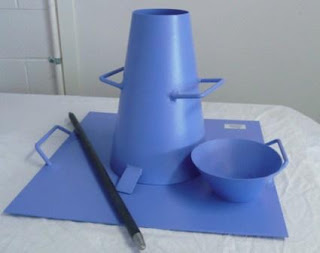
AIM To determine the workability of fresh concrete by slump test as per IS: 1199 - 1959 APPARATUS SLUMP CONE

Aggregate Crushing Value

Image
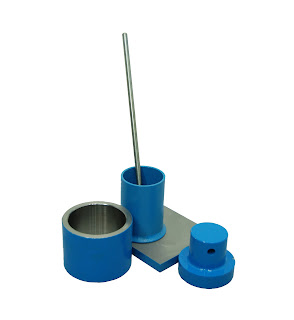
AIM To determine the aggregate crushing value of coarse aggregates as per IS: 2386 (Part IV) - 1963.  APPARATUS CYLINDRICAL MEASURE AND PLUNGER

Aggregate impact value

Image
AIM To determine the aggregate impact value of coarse aggregates as per IS: 2386 (Part IV) - 1963. APPARATUS AGGREGATE IMPACT TEST MACHINE Impact testing machine conforming to IS: 2386 (Part IV) - 1963 IS Sieves of sizes - 12.5mm, 10mm and 2.36mm A cylindrical metal measure of 75mm dia. and 50mm depth A tamping rod of 10mm circular cross section and 230mm length, rounded at one end Oven  PREPARATION OF SAMPLE   The test sample should conform to the following grading: - Passing through 12.5mm IS Sieve 100% - Retention on 10mm IS Sieve 100% The sample should be oven-dried for 4hrs. at a temperature  of 100 to 110oC and cooled. The measure should be about one-third full with the prepared  aggregates and tamped with 25 strokes of the tamping rod.  A further similar quantity of aggregates should be added and  a further tamping of 25 strokes given. The measure should  finally be filled to overflow, tamped 25 times ...

Aggregates - Abrasion Value

Image
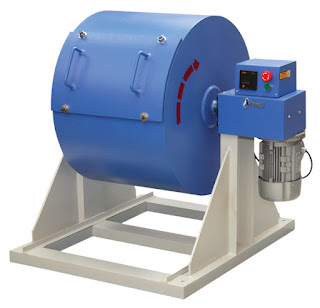
AIM To determine the abrasion value of coarse aggregates as per IS: 2386 (Part IV) - 1963.  APPARATUS LOS ANGLES MACHINE Los Angles abrasion testing machine IS Sieve of size - 1.7mm Abrasive charge - 12 nos. cast iron or steel spheres  approximately 48mm dia. and each weighing between 390 and 445g ensuring that the total weight of charge is 5000 + 25g Oven PREPARATION OF SAMPLE The test sample should consist of clean aggregates which has been dried in an oven at 105 to 110o C to a substantially constant weight and should conform to one of the gradings shown in the table below:  PROCEDURE   The test sample and the abrasive charge should be placed in the Los Angles abrasion testing machine and the machine rotated at  a speed of 20 to 33 revolutions/minute for 1000 revolutions. At the completion of the test, the material should be discharged and sieved through 1....

Aggregates - Sieve Analysis

Image
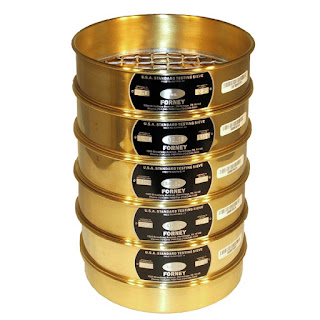
AIM To determine the particle size distribution of fine and coarse aggregates by sieving as per IS: 2386 (Part I) - 1963. PRINCIPLE By passing the sample downward through a series of standard sieves, each of decreasing size openings, the aggregates are separated into several groups, each of which contains aggregates in a particular size range. APPARATUS A SET OF IS SIEVES  A set of IS Sieves of sizes - 80mm, 63mm, 50mm, 40mm, 31.5mm, 25mm, 20mm, 16mm, 12.5mm, 10mm, 6.3mm, 4.75mm, 3.35mm, 2.36mm, 1.18mm, 600μm, 300μm, 150μm and 75μm. Balance or scale with an accuracy to measure 0.1 percent of the weight of the test sample. SAMPLE The weight of sample available should not be less than the weight given below:- The sample for sieving should be prepared from the larger sample either by quartering or by means of a sample divider. PROCEDURE  The test sample is dried to a constant weight at a temperature of 110 ...

Cement Test - Soundness

Image
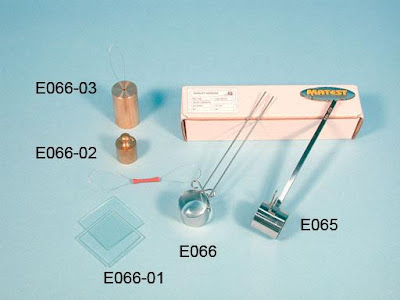
AIM To determine the soundness of cement by Le-Chatelier method as per IS: 4031 (Part 3) - 1988. APPARATUS LE-CHATELIER'S TEST APPARATUS

Cement Test - Initial And Final Setting Time

AIM To determine the initial and the final setting time of cement as per IS: 4031 (Part 5) - 1988. APPARATUS Vicat apparatus conforming to IS: 5513 - 1976  Balance, whose permissible variation at a load of 1000g should be +1.0g Gauging trowel conforming to IS: 10086 - 1982  PROCEDURE  Prepare a cement paste by gauging the cement with 0.85 times the water required to give a paste of standard consistency (see Para 1.2). Start a stop-watch, the moment water is added to the cement. Fill the Vicat mould completely with the cement paste gauged as above, the mould resting on a non-porous plate and smooth off the surface of the paste making it level with the top of the mould. The cement block thus prepared in the mould is the test block. A) INITIAL SETTING TIME Place the test block under the rod bearing the needle. Lower the needle gently in order to make contact with the surface of the cement paste and release quickly, allowing it t...

Cement Test - Consistency

Image
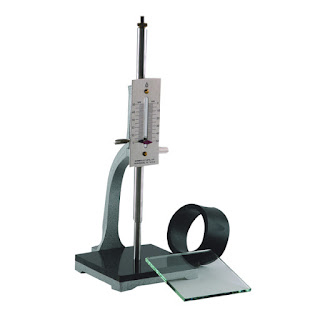
AIM To determine the quantity of water required to produce a cement paste of standard consistency as per IS: 4031 (Part 4) - 1988. PRINCIPLE The standard consistency of a cement paste is defined as that consistency which will permit the Vicat plunger to penetrate to a point 5 to 7mm from the bottom of the Vicat mould. APPARATUS VICAT APPARATUS Vicat apparatus conforming to IS: 5513 - 1976 Balance, whose permissible variation at a load of 1000g should be +1.0g  Gauging trowel conforming to IS: 10086 - 1982  PROCEDURE Weigh approximately 400g of cement and mix it with a weighed quantity of water. The time of gauging should be between 3 to 5 minutes. Fill the Vicat mould with paste and level it with a trowel. Lower the plunger gently till it touches the cement surface. Release the plunger allowing it to sink into the paste. Note the reading on the gauge.  Repeat the above procedure taking fresh samples of cement and different quantities ...

Cement Test - Fineness

Image
AIM To determine the fineness of cement by dry sieving as per IS: 4031 (Part 1) - 1996. PRINCIPLE The fineness of cement is measured by sieving it through a standard sieve. The proportion of cement, the grain sizes of which, is larger than the specified mesh size is thus determined. APPARATUS IS SIEVE  Balance capable of weighing 10g to the nearest 10mg 90μm IS Sieve  A nylon or pure bristle brush, preferably with 25 to 40mm bristle, for cleaning the sieve PROCEDURE  Weigh approximately 10g of cement to the nearest 0.01g and place it on the sieve. Agitate the sieve by swirling, planetary and linear movements, until no more fine material passes through it. Weigh the residue and express its mass as a percentage R1, of the quantity first placed on the sieve to the nearest 0.1 percent. Gently brush all the fine material off the base of the sieve. Repeat the whole procedure using a fresh 10g sample to obtain R2. Then calculate R a...